Ever feel like your mind is a high-speed train, rushing through deadlines, distractions, and a to-do list that never ends? In today’s always-on world, the idea of true stillness can feel out of reach. But what if peace isn’t about emptying your mind — what if it’s about filling it with intention, color, and a little creative magic? Welcome to mindful art, a calming, evidence-based path to wellness that engages both the mind and body.
Beyond the Brushstroke: Why Mindful Art is Your Next Wellness Secret
Mindful art is more than just drawing or coloring—it’s an act of conscious creation that integrates mindfulness and artistic expression. This fusion has a measurable impact on mental, emotional, and physical health, backed by science and accessible to all.
-
Your Personal Stress Eraser : When you shift your focus to the movement of a brush or the feel of clay, your brain naturally begins to enter a meditative state. This activity significantly reduces cortisol, the stress hormone. According to a 2016 study by Kaimal et al., participants who engaged in 45 minutes of creative activity experienced a reduction in cortisol levels in 75% of cases, regardless of their skill level(Kaimal, Ray, & Muniz, 2016). This stress reduction isn’t just psychological; it’s physiological. Art becomes a kind of neural “vacation” — giving the body permission to slow down, relax, and reset (Stuckey & Nobel, 2010).
-
The Art of Deep Focus in a Distracted World : With attention spans dropping to just 8.25 seconds on average — shorter than a goldfish’s (Statistic Brain, 2015) — our ability to focus is more under threat than ever. Mindful art acts as resistance training for your attention. Through repeated creative engagement, individuals develop increased capacity for sustained concentration (van der Vennet & Serice, 2012). Neuroscientific studies suggest that when people enter a “flow” state — a deep immersion in the creative process — the prefrontal cortex deactivates slightly, allowing for heightened focus and present-moment awareness (Dietrich, 2004).
-
A Vibrant Canvas for Your Emotions : Words don’t always capture the full spectrum of human emotion. Visual expression allows for a safe, non-verbal release. Art therapy has been shown to reduce symptoms of depression and anxiety, with a noted improvement in emotional clarity and self-awareness (Haeyen, van Hooren, & Hutschemaekers, 2015). In fact, a study published in The Arts in Psychotherapy reported that participants using expressive art practices experienced a 37% improvement in emotional regulation (Czamanski-Cohen & Weihs, 2016).
-
Unleash Your Inner Creator (No “Talent” Required!) : The beauty of mindful art lies in its freedom from judgment. Whether you’re scribbling in a notebook or molding clay with your fingers, you’re engaging your brain’s default mode network — associated with imagination and introspection (Beaty et al., 2014). This network fosters divergent thinking, crucial for problem-solving and innovation.Studies show that creative tasks can enhance cognitive flexibility by up to 25%, even in individuals who don’t identify as “creative” (Zabelina & Robinson, 2010). Letting go of perfection unlocks new ways of thinking that extend beyond the art space and into daily life.
-
Cultivating Self-Compassion & Acceptance : Mindful art teaches us to embrace imperfection. There is no failure — only flow. This practice encourages self-compassion, which research has linked to increased emotional resilience and lower anxiety (Neff, 2003).A 2021 study found that those who regularly practiced mindful art reported a 28% improvement in self-acceptance and a 23% reduction in self-criticism (Potash et al., 2021). When the goal is the process itself — not the outcome — it becomes easier to release harsh inner judgments and simply enjoy the moment.
Ready to Begin Your Artful Journey?
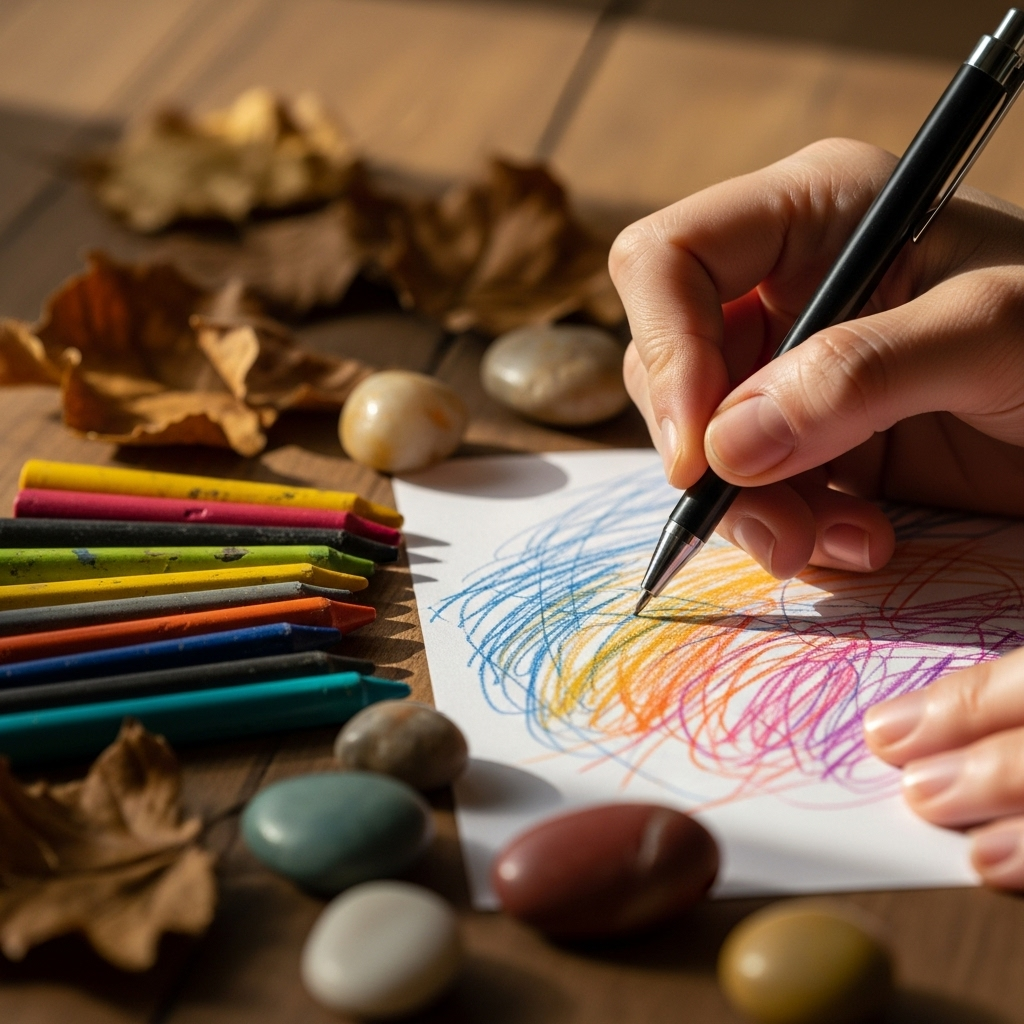
You don’t need expensive supplies, formal training, or hours of free time. All you need is intention. Start with a pen and paper, old crayons, or even leaves and stones from your backyard. Just a few minutes of mindful creativity each week can unlock a cascade of wellness benefits — calming the mind, expanding focus, and deepening self-connection. So go ahead. Give yourself permission to slow down. Paint, scribble, shape, or color — and watch your inner oasis come to life.
References
- Beaty, R. E., Benedek, M., Silvia, P. J., & Schacter, D. L. (2014). Creative cognition and brain networks: Default and executive network contributions to creative idea production. Neuropsychologia, 64, 92-98. https://doi.org/10.1016/j.neuropsychologia.2014.09.008
- Czamanski-Cohen, J., & Weihs, K. L. (2016). The bodymind model: A platform for studying the mechanisms of change induced by art therapy. The Arts in Psychotherapy, 51, 63–71. https://doi.org/10.1016/j.aip.2016.08.006
- Dietrich, A. (2004). Neurocognitive mechanisms underlying the experience of flow. Consciousness and Cognition, 13(4), 746–761. https://doi.org/10.1016/j.concog.2004.07.002
- Haeyen, S., van Hooren, S., & Hutschemaekers, G. (2015). Perceived effects of art therapy in the treatment of personality disorders: A qualitative study. The Arts in Psychotherapy, 45, 1–10. https://doi.org/10.1016/j.aip.2015.04.005
- Kaimal, G., Ray, K., & Muniz, J. (2016). Reduction of cortisol levels and participants’ responses following art making. Art Therapy, 33(2), 74–80. https://doi.org/10.1080/07421656.2016.1166832
- Neff, K. D. (2003). The development and validation of a scale to measure self-compassion. Self and Identity, 2(3), 223–250. https://doi.org/10.1080/15298860309027
- Potash, J. S., Ho, R. T. H., Chan, F., Wang, X. L., & Cheng, C. (2021). Can art therapy reduce death anxiety and burnout in end-of-life care workers? A quasi-experimental study. International Journal of Environmental Research and Public Health, 18(2), 839. https://doi.org/10.3390/ijerph18020839
- Statistic Brain. (2015). Attention span statistics. https://www.statisticbrain.com/attention-span-statistics/
- Stuckey, H. L., & Nobel, J. (2010). The connection between art, healing, and public health: A review of current literature. American Journal of Public Health, 100(2), 254–263. https://doi.org/10.2105/AJPH.2008.156497
- van der Vennet, R., & Serice, S. (2012). Can coloring mandalas reduce anxiety? Art Therapy, 29(2), 87–92. https://doi.org/10.1080/07421656.2012.680047
- Zabelina, D. L., & Robinson, M. D. (2010). Creativity as flexible cognitive control. Psychology of Aesthetics, Creativity, and the Arts, 4(3), 136–143. https://doi.org/10.1037/a0017379